Approvals that pile up before month-end
Staff spend the first week of every month chasing sign-offs by phone and email.

AI agents and custom software from Utrecht
Bring us one process or one product idea. On Loom, our agent platform, an AI agent runs your process by the end of the day, with a person approving every action. In our AI software factory, a working first version of your product (an MVP) is in your hands in three days.
Agent intelligence
Built for










Every organisation has work that lives between its applications. Someone chases it, retypes it or has to read it first. That is the work we hand to agents.
Staff spend the first week of every month chasing sign-offs by phone and email.
Revenue statements retyped, split by hand and entered into the accounting system, store by store.
A diploma, an insurance certificate or an invoice waits for a person before the process can continue.
A chat demo impresses, but nothing connects it to the systems where the work actually happens.
One shift, from start to finish
Twenty-four hours after a shift ends, the agent reads it from the scheduling system and checks the hours and breaks against the rules. A shift longer than 5.5 hours needs at least 30 minutes of break.
Agents on top of an existing platform, integrations around a screening product, and an invoicing engine that replaced a spreadsheet.
Customer case / AI agents
Four agents that check shifts, chase approvals and handle withdrawals for a staffing agency in healthcare. People handle only the exceptions.
Customer case / Integrations
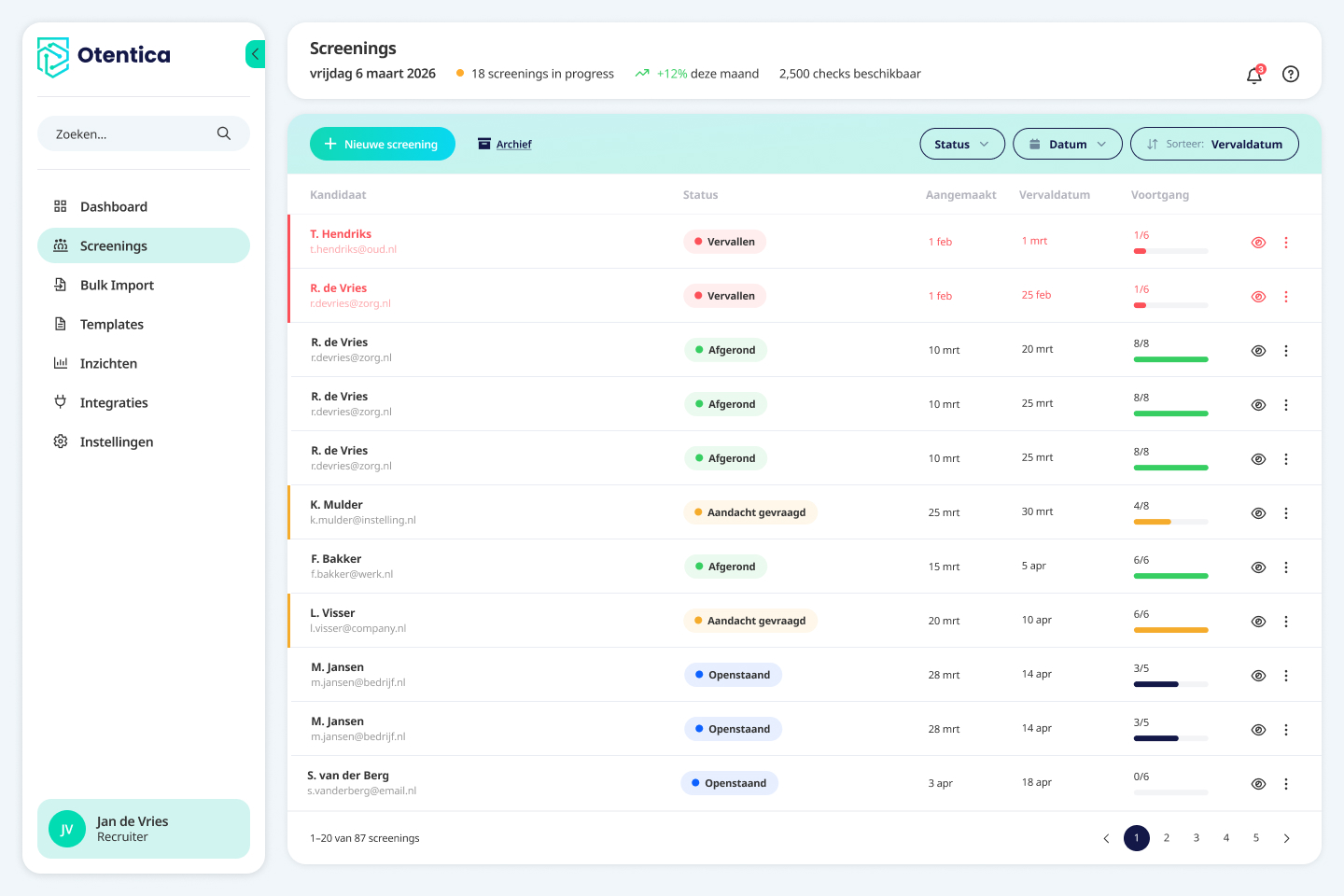
The integration partner behind a screening platform used by more than a hundred organisations for over 850,000 screenings.
Customer case / Custom software
A revenue-allocation and invoicing application for an accounting firm that administers shop-in-shop concessions in two national supermarket chains.
Our platform
Loom is the platform we build customer agents on. Connect the APIs you already have, draw the workflow or describe it, give an agent its instructions and tools, put a person at the decision points, and follow every run step by step. That is why one process becomes a running agent in a single day. You get your own login. Change workflows yourself, or let our team run everything for you.
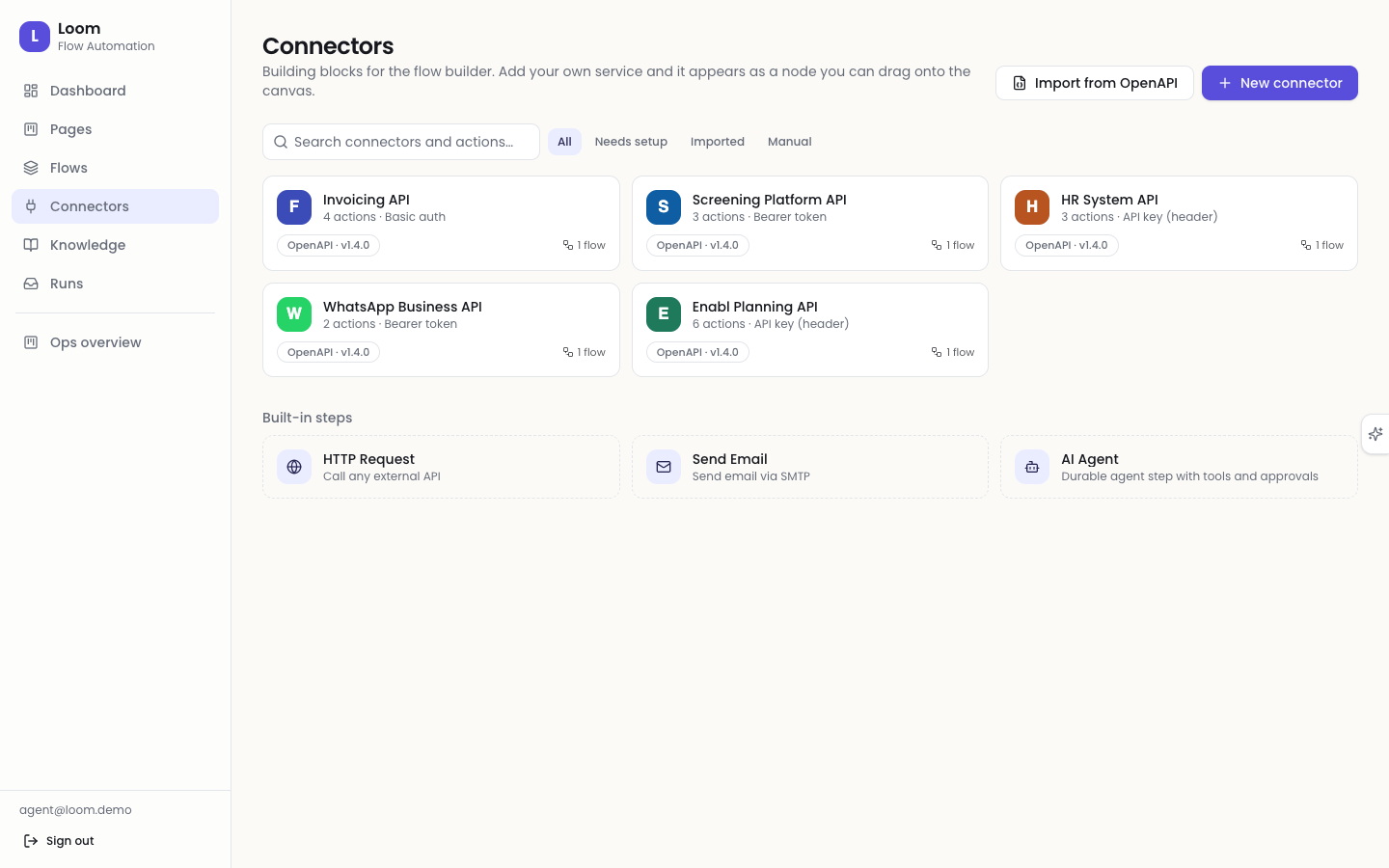
Import an OpenAPI or Power Platform definition, or describe an endpoint by hand. API keys, bearer, basic and OAuth2. Every endpoint becomes a step in a workflow and a tool for an agent.
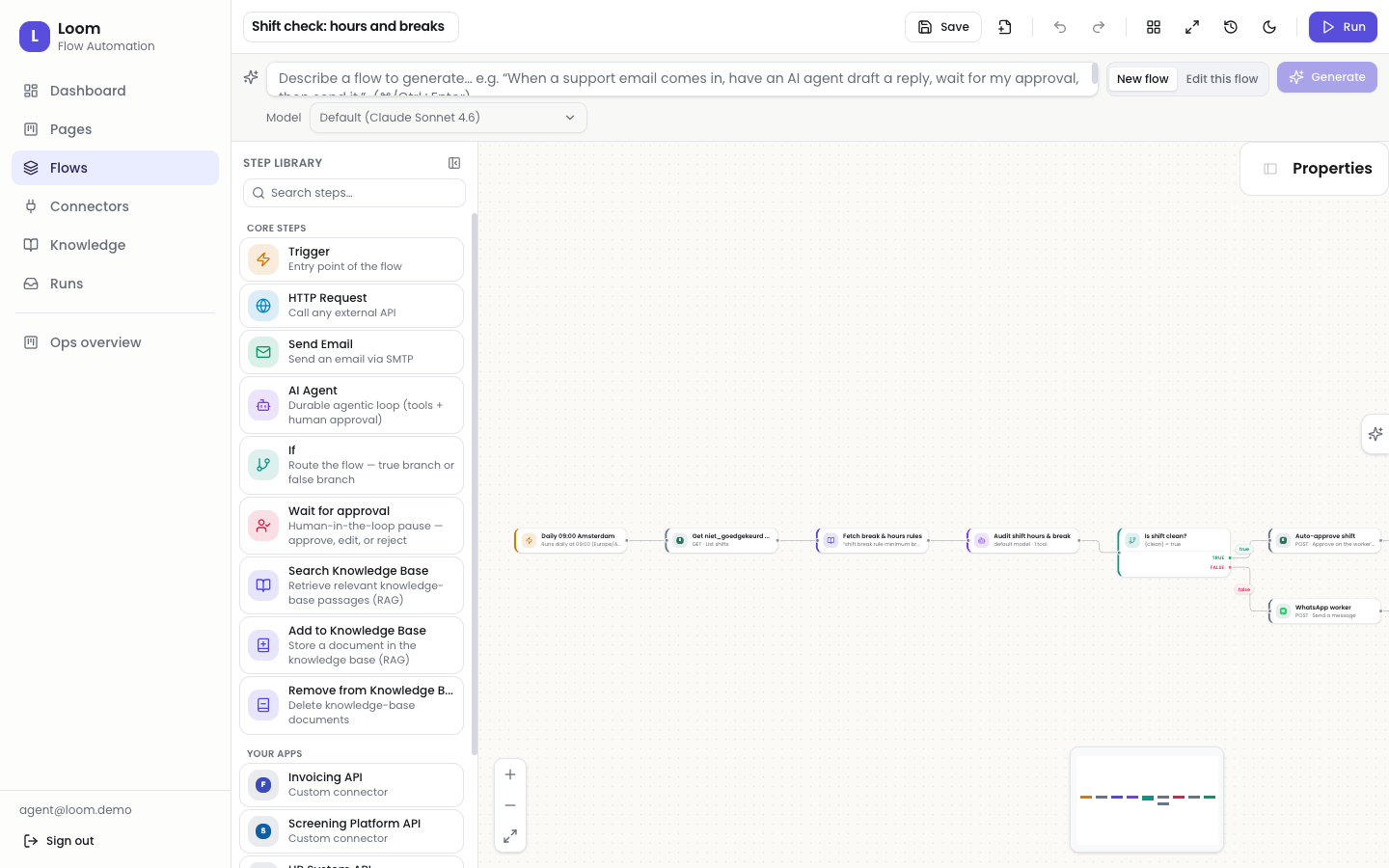
Draw the process, or describe it in a sentence and let Loom draft it for you to review. Start it from a webhook, a schedule, a poll or by hand. Branch on conditions and test every step with real data.
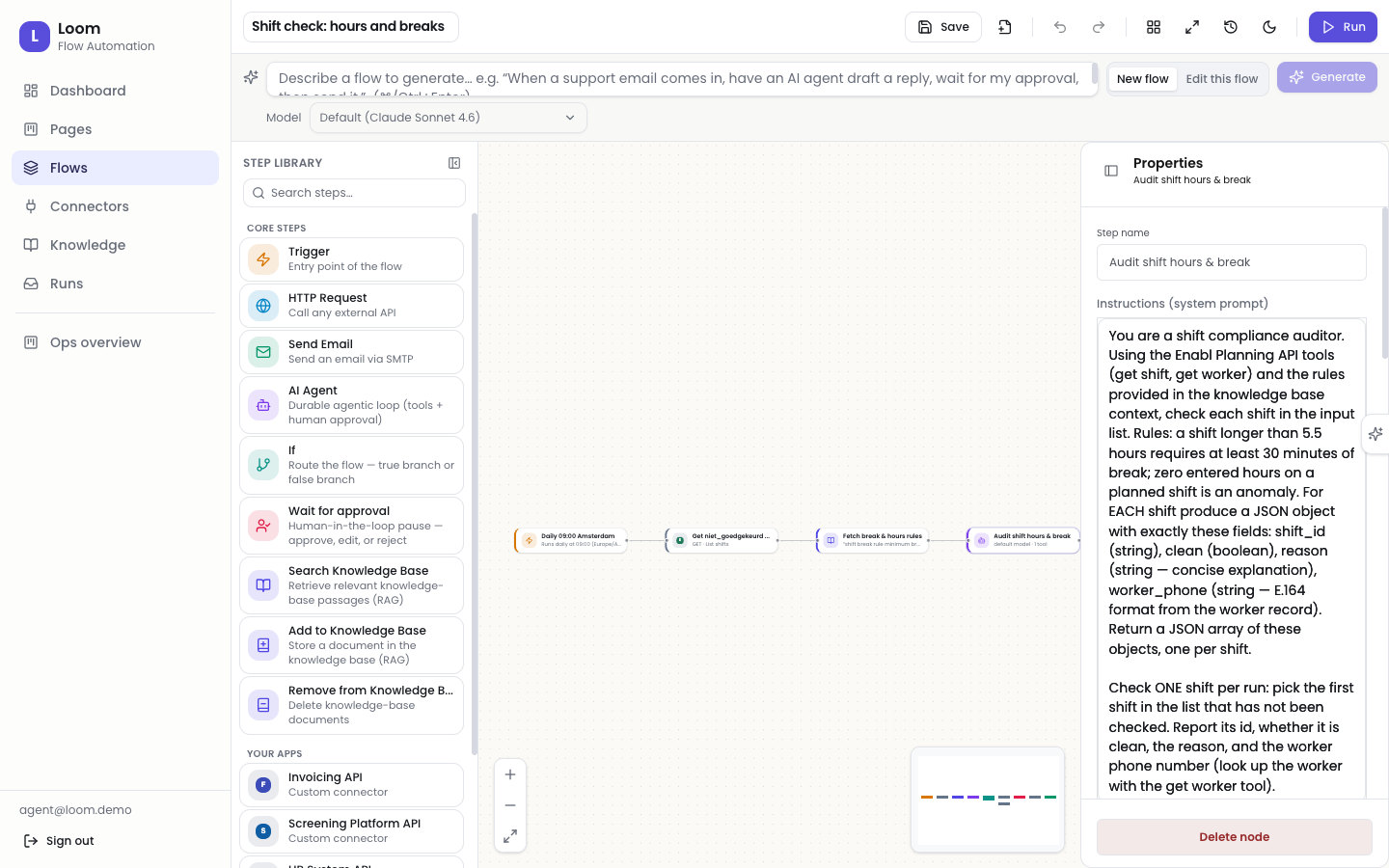
Give an agent its instructions, a model of your choice, the tools it may use and a fixed output the next step can rely on. Optional access to your knowledge base.
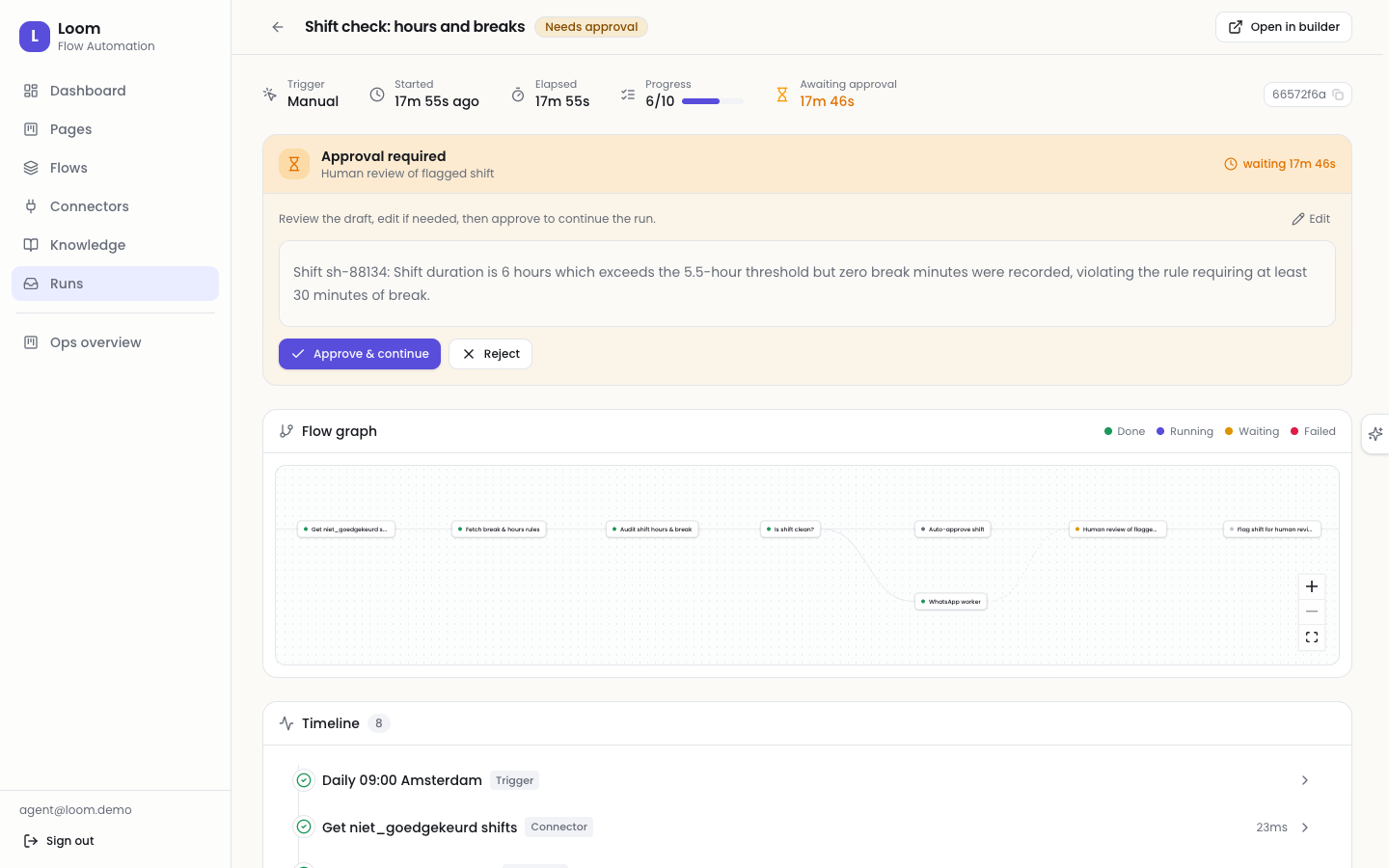
A pause in the workflow where a person reviews, edits and approves or rejects, with an optional time limit. The run waits as long as it needs to and continues where it stopped.
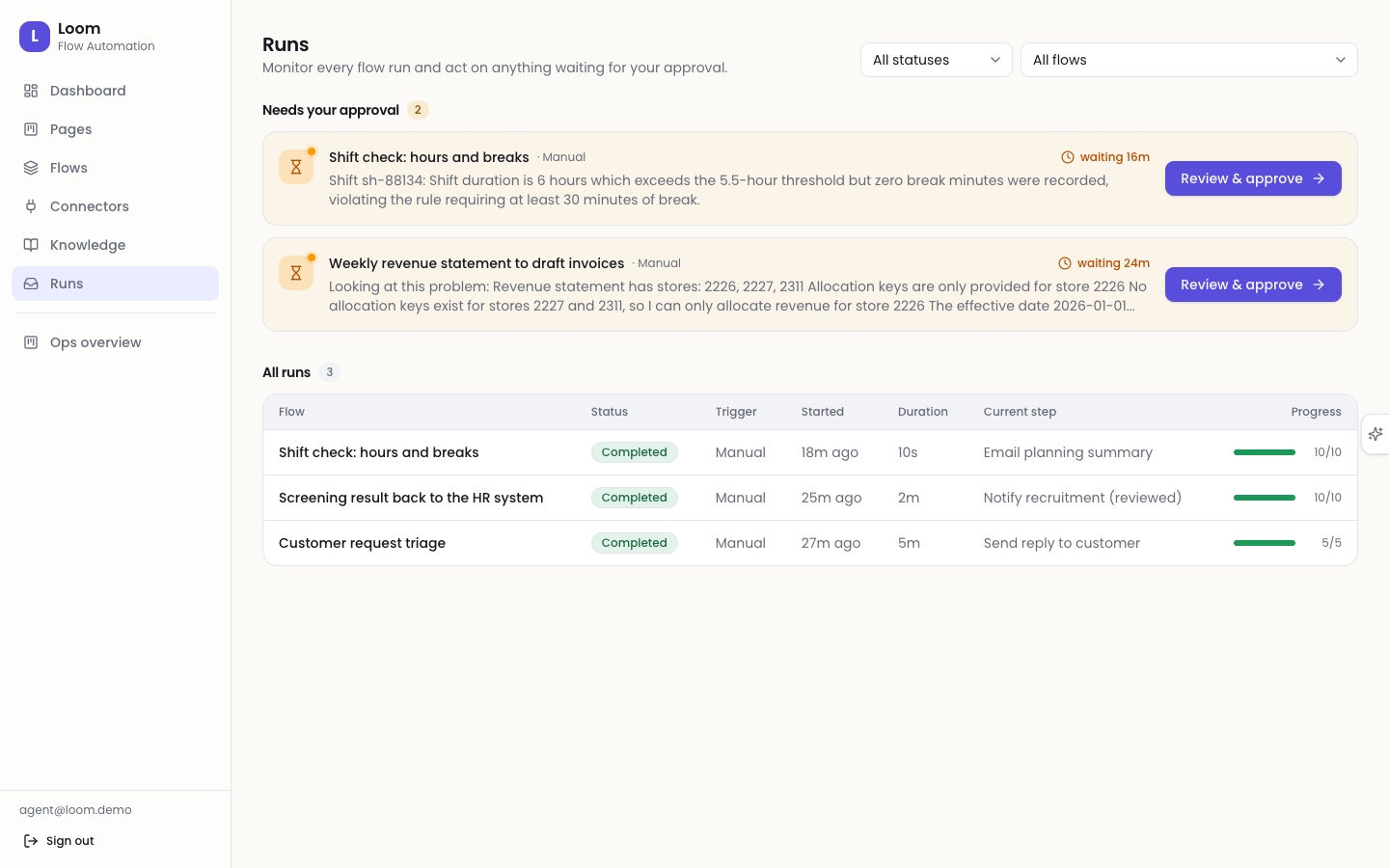
An inbox that puts “needs your approval” first. For every run you see the graph, the timeline, the agent’s conversation and every tool call.
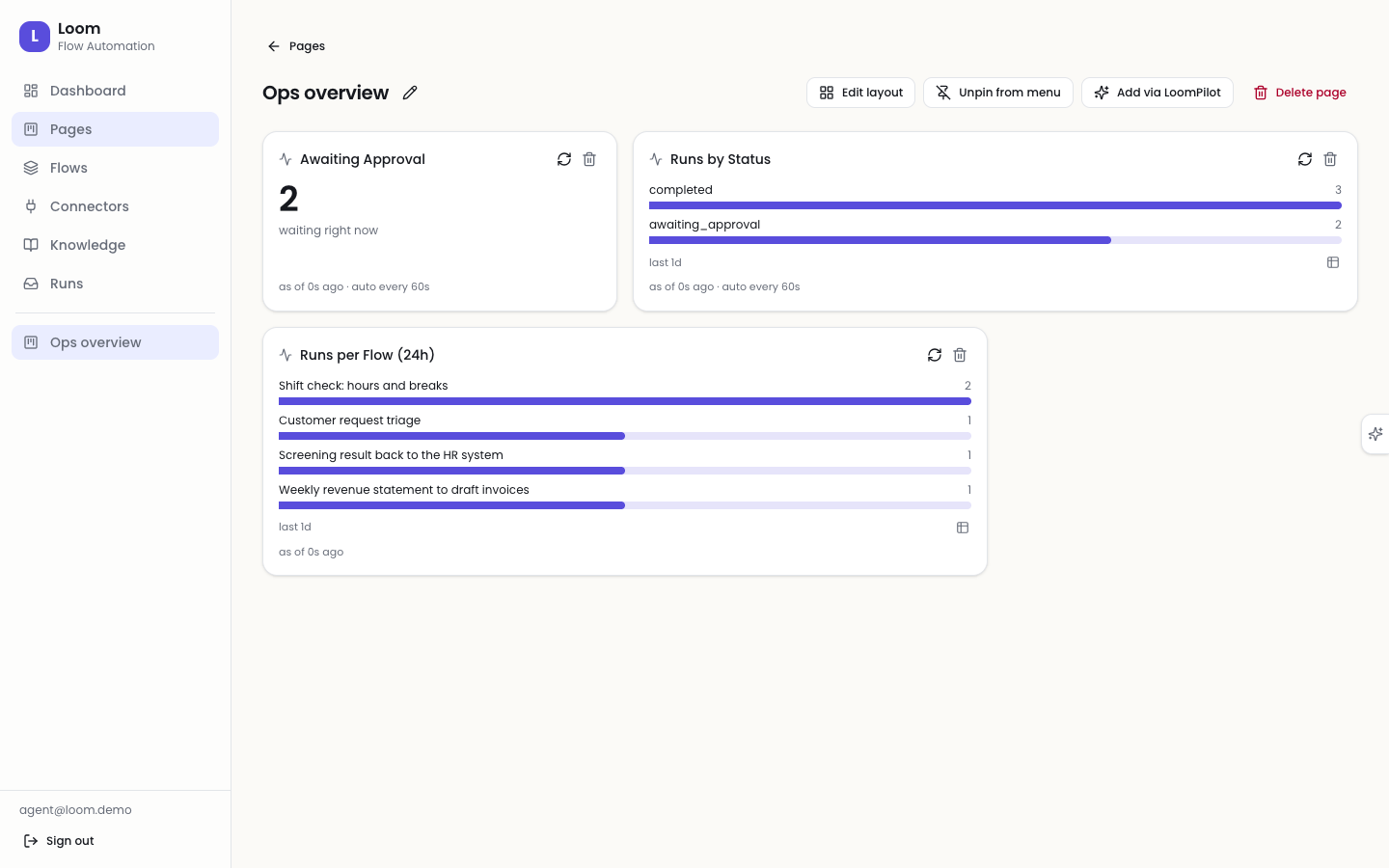
A knowledge base your agents can search, a playground to test what they will find, and LoomPilot, the assistant that answers questions about your workflows and runs and pins the answer as a live chart on a page.
Pick the one that matches what you bring. A process, a product idea, or a system that has to last for years.
On Loom. From a simple check to a process with several steps, API calls, AI decisions and human approval. Running by the end of the day, with a person approving each action until you decide otherwise. Manage it yourself or let us manage it.
How the day goesIn our AI software factory. We gather the requirements with you, set up the architecture, and let AI coding agents build the software under our engineers’ review. Screens, integrations and data connected. A working first version of your product (an MVP) in your hands on day three.
How the three days goWhen your organisation needs a system of its own. Multi-agent platforms, screening integrations, revenue and invoicing engines, and the APIs and data mappings between them. Weeks rather than days. See FAIR, Otentica and Finoptis.
See the casesUseful automation needs clear responsibility. Before an agent changes anything, we agree what it may read, what it may change and when a person decides. Then we build those choices into the workflow.
An agent decides and records before it is allowed to change anything.
Every write carries the agent’s identity in the audit log of your system.
In Loom, a human decision is a step in the workflow. The run waits for it.
Every Loom run keeps its graph, its timeline, the agent’s conversation and every tool call.
Agents read through the API and write back only what was agreed.
Model access runs through your own API key, so usage and data stay under your account.
The agent day
Bring one process and access to the system it lives in. By the end of the day an agent runs it on Loom, from a simple check to a process with several steps, API calls, AI decisions and a person at the decision points. You watch its first real runs before you go home.
| When | What we do together | What you have |
|---|---|---|
| Beforehand, 30 minutes | Pick the process, agree who decides, arrange access to the API | A one-page brief |
| Morning | Map the steps and the exceptions. Import the API into Loom and connect it | Your system connected to Loom |
| Afternoon | Build the workflow. Give the agent its instructions and tools. Add the approval steps. Test with real data | A running agent with a person approving each action |
| End of the day | Watch the first real runs together. Decide what to fine-tune | The agent in your process, every run on record |
| Afterwards | Fine-tune. Decide what may run without approval. Manage it yourself, or we do | An agent in production |
One process. A system with an API or an OpenAPI description. Access arranged before the day.
The AI software factory
In our software factory, AI coding agents write the code. Our engineers sit down with you, gather the requirements, write the product requirements document, cut it to what fits in three days, set up the architecture and review every piece. The factory is tuned so that a working first version of your product, an MVP with screens, integrations and data connected, is delivered in three days.
| Step | What we do | What you have |
|---|---|---|
| Requirements | We sit down with you, gather everything the first version needs and write the product requirements document | A requirements document you have approved |
| Scope | We cut the document down to what fits in three days and agree what comes after | A scope you can hold us to |
| Architecture | We set up the application’s architecture, the foundation the coding agents build on | A deployed skeleton with the right shape |
| Build | AI coding agents build the screens, the integrations and the data layer. Our engineers review every piece | A working product taking shape on a URL |
| Delivery | Everything connected and handed over, with a plan for what comes next | A working first version in your hands |
One product. The core flow from start to finish, connected. Certifications and multi-tenant hardening come in the weeks after, not inside the three days.
Some work is a platform, not a workflow. Then we run a longer track: kickoff and a technical deep dive with your team and your software vendor, building in signal mode, an acceptance test with your staff, and going live one agent at a time. FAIR’s first release ran that way in six weeks.
Our background is software architecture, application development and the recovery of projects that had gone off the rails. That is why we care about the unglamorous parts, the audit log, the write that can never be applied twice, the one source of truth. And why an agent from us acts inside your real systems rather than in a demo.
The way we work is simple. Engineers sit down with you and set the requirements and the architecture. AI agents write the code. Loom runs the agents. One team, led from Utrecht, with engineers in Tirana and Skopje.
Let’s talkStart with a recurring task that costs time and has a clear result. Together we look at the available data, the systems involved and the decisions that need a person. That gives a practical first use case, and usually a good agent day.
Yes, as long as your software offers an API or another way to connect. We check access, permissions and data quality before we choose an approach.
No. Loom is how we build fast and keep people in control. If your situation calls for custom software, our AI software factory builds it.
As a service in our private cloud. You get your own login.
Yes. Workflows, connectors, approvals and knowledge are all in the interface. Or leave it to us and we manage everything for you.
One day on Loom for an AI agent. Three days in our AI software factory for a working first version of your product. A platform of your own takes weeks.
From a simple check to a process with several steps, API calls, AI decisions and human approval. Loom’s building blocks are what make a complex process possible in a day.
A working first version of your product, an MVP. The core flow from start to finish, with screens, integrations and data connected, running on a URL. Not a certified, multi-tenant product yet. That is what the weeks after are for.
AI coding agents in our software factory. Our engineers gather the requirements, set the architecture and review every piece. You get code you can read and own.
We agree which actions an agent may take, where approval is needed and when it has to escalate. Those boundaries become steps in the workflow, together with monitoring and a record of every action.
Monitoring, support and a next iteration. Yourself in Loom, or fully managed by our team.
Tell us which task your team keeps repeating, or which product you want to put in someone’s hands, and who decides. Within one working day you get a date. An agent day, or a three-day build.
One day for an agent. Three days for a first version. Bring it along and see for yourself.